Archive

Posts Tagged ‘C language’

A tiny printf for embedded systems

January 17th, 2011 3 comments


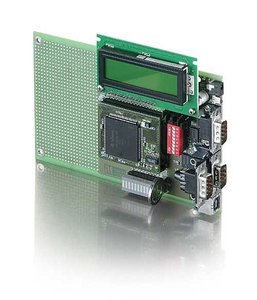
Often embedded systems have small amount of RAM and flash, so you could have the need of specifically written standard functions.

The endianness problem and how to test the endianness

December 12th, 2010 No comments

<"In computing, endianness is the ordering of individually addressable sub-units (words, bytes, or even bits) within a longer data word stored in external memory. The most typical cases are the ordering of bytes within a 16-, 32-, or 64-bit word, where endianness is often simply referred to as byte order.[1] The usual contrast is between most versus least significant byte first, called big-endian and little-endian respectively. Mixed forms are also possible; the ordering of bytes within a 16-bit word may be different from the ordering of 16-bit words within a 32-bit word, for instance; although fairly rare, such cases exist, and may sometimes be referred to as mixed-endian or middle-endian.

Network programming: UDP client/server source

February 28th, 2010 No comments

With this post, the mini-serie dedicated to the simple udp client server ends.

Network programming: demonize

January 14th, 2010 No comments

Demonizing the Server

A server, to be a real server shall be able to run as a demon, it shall run in background and it shall not be linked to a terminal. To do this I'll add two functions to the simple server:

  1. demonize
  2. detachFromTerminal

Network programming: simple udp client server #2

January 10th, 2010 3 comments

The Client.

The following code contains the implementation for the UDP client application that can send data to the server explained in the previous article.

Network programming: simple udp client server #1

January 4th, 2010 No comments

The Server.

In this small series I'll show you how to write a simple UDP Client/Server system in a Unix environment using the C language. The server waits data listening on a port specified by the user, if the received data contains ".quit." string the server exits.

Statistical data collected by Statpress SEOlution (blogcraft).